// 03 · E-commerce · Merchandising · 2022 — 2024
Nykaa
Making cart and offers legible at scale

// Overview
I owned the Offers, Coupons and Cart Rules experience for Nykaa Beauty's bottom funnel — the layer where users perceive value, gratification and fairness across the shopping journey.
The team came in expecting to redesign the coupon and offer cards. We stepped back, ran a research-led audit, aligned four cross-functional teams around a shared definition of the problem, reshaped the copy system underneath, and only then started shipping UX changes.
The compounding effect: stronger checkouts, higher AOVs, and a clearer incentive system that — over time — does the quieter work of building trust and bringing users back.
// Problem & context
Owning the bottom funnel meant being accountable for Add to Cart, AOV, ABS, Pay Now → Checkout conversion, coupon adoption and revenue per visit. But the real ownership wasn't a metric. It was a question: do users instantly understand the value we're offering and the action it takes to unlock it? For most of the offers ecosystem when I took it on, the honest answer was no.
The obvious work was visual — tighten the UI, fix the hierarchy, ship a cleaner experience. But the cards were a symptom. What had quietly snowballed as Nykaa scaled was the layer underneath: more brands, more concurrent offers, more cart rules stacked on top of each other, all generated through manual processes that worked at a smaller catalogue and broke as it grew.
Marketing, brand, product and the cart rules team were each shaping fragments of the same experience with no shared definition of “good.” Offer copy was written manually with no template, character limits or guardrails. And the “collect coupon” model didn't match what users expected from every other commerce platform — collect it, and it still might not apply.
// Process
// The first unlock
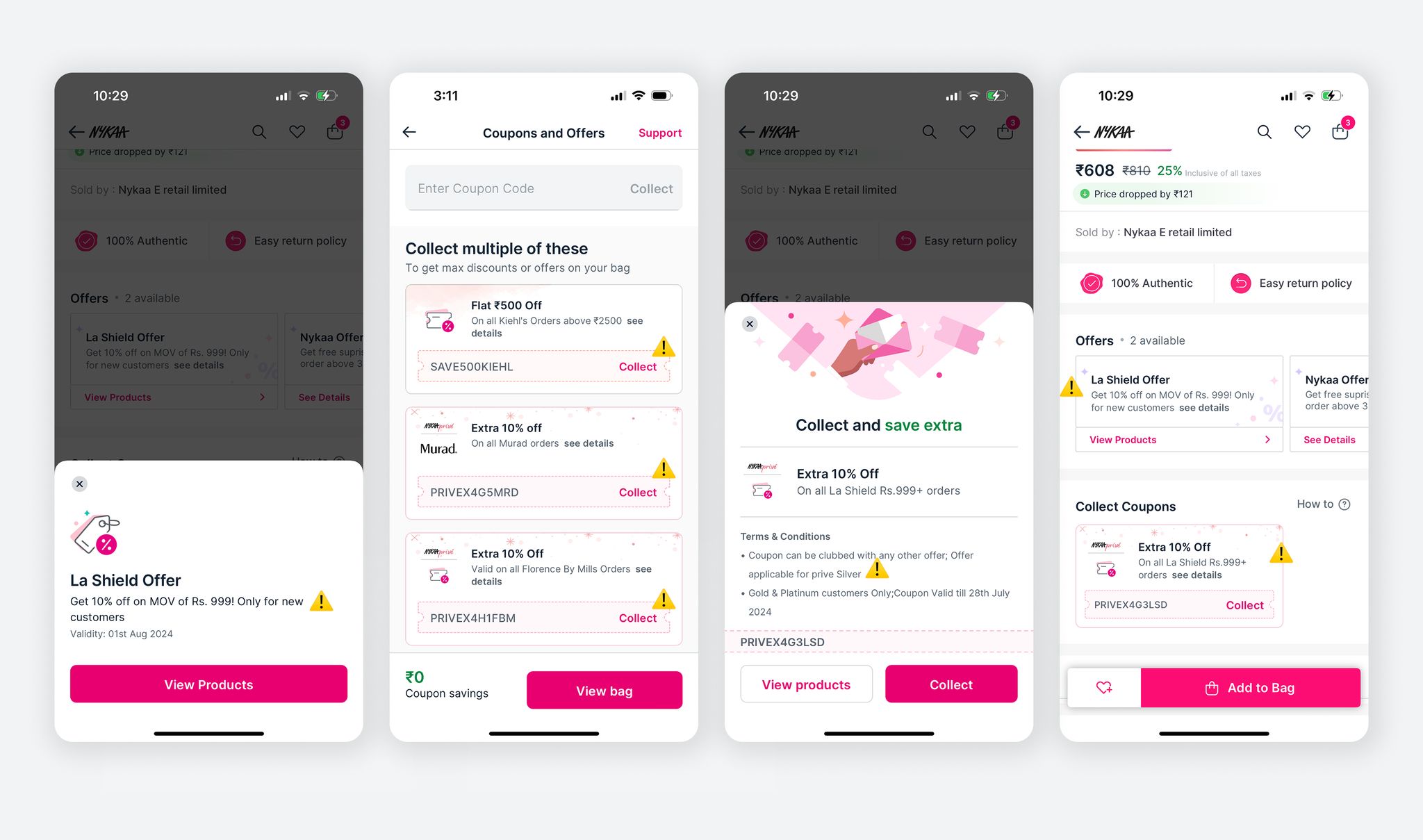
The first real milestone wasn't a design. It was getting marketing, brand, product and the cart rules team into a single room — and getting them to agree there was a shared problem worth solving together.
We presented the audit findings: where users were dropping off, why the copy wasn't working, how different teams were unknowingly working against each other, and what Swiggy, Tata Cliq, Zepto and Ajio were doing differently. Then we proposed a direction — clarity-led incentivisation. The win wasn't a sign-off on designs; it was an acknowledgement that this was a shared problem whose gravity warranted shared ownership.
// Filling the gaps no one owned
Acknowledgement didn't translate into prioritisation. The copy problem stayed unowned. We could have handed it back and waited. We didn't — we built the copy templates ourselves.
Every offer construct Nykaa runs (MOV-based, percentage-off, BxGy, free gift, brand-funded, payment-linked, laddered) was mapped to a clean heading-and-subheading pattern, with rules for casing, currency symbols, tone and character limits. We ran each past brand and marketing for operational viability, pushed back on legacy constructs that didn't survive the template, and let the rest generate copy automatically from offer type, value and conditions. We did the same with the cart rules team to push for an SOP — work that sat outside our KRAs entirely.
Good design is whatever the user needs it to be — sometimes that's a card in a Figma file, sometimes it's a copy template on an Excel sheet.
// A. Delta communications (Q3 FY25)
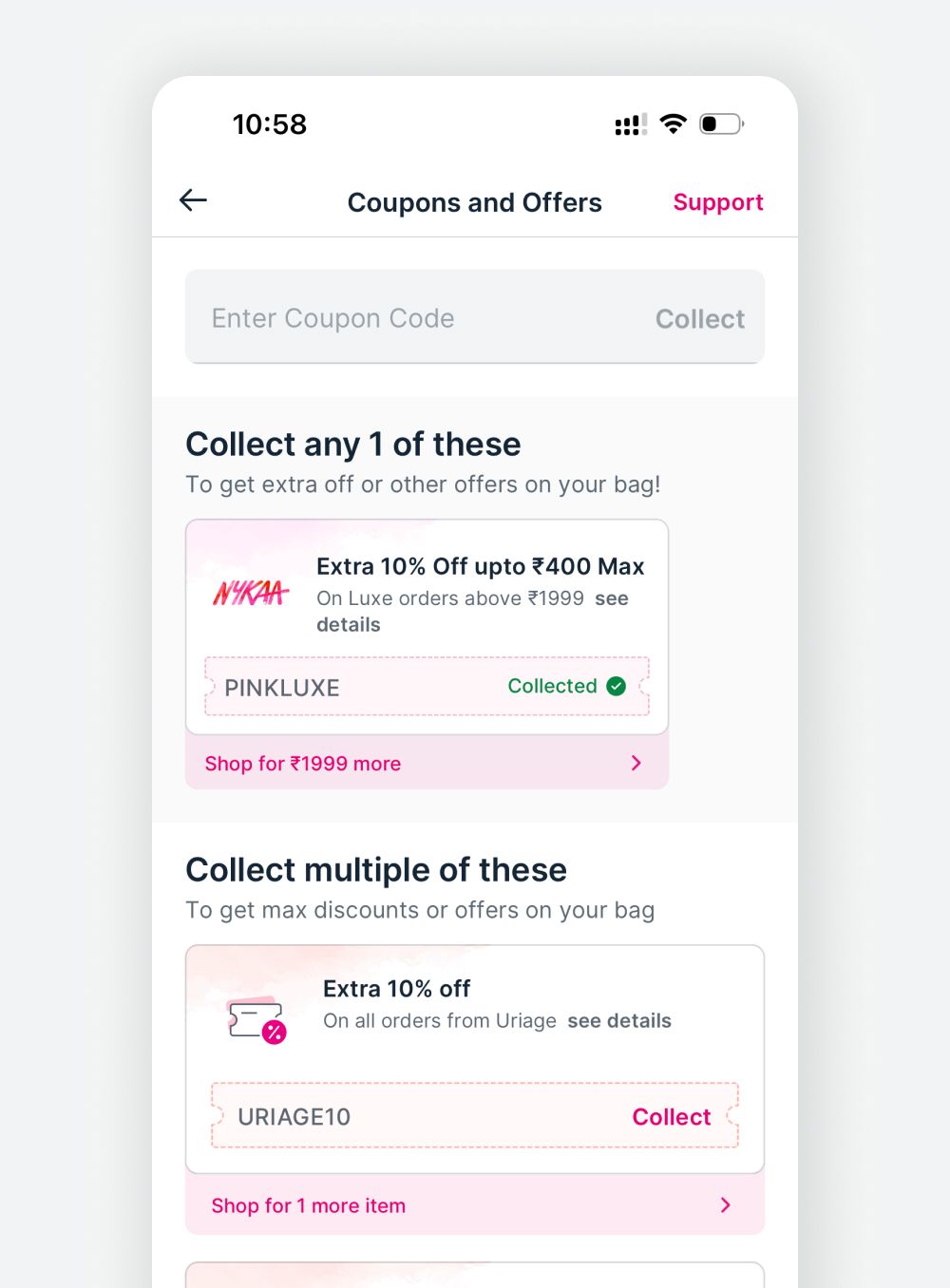
A small change with disproportionate impact. We added one line to every coupon and offer card: how much more the user needed to shop for to unlock the offer. “Shop ₹299 more.” “Add 2 more items.” No mental math, no guesswork — passive information became actionable guidance.
PDP → Order +2.5%. Coupons Page → Order +1.12%. AOV +₹4. ABS +1 bps with CVR held. Revenue per visit +₹0.49 (+0.7%).
// B. Removing “Collect” — the hardest change to land (Q3 FY26)
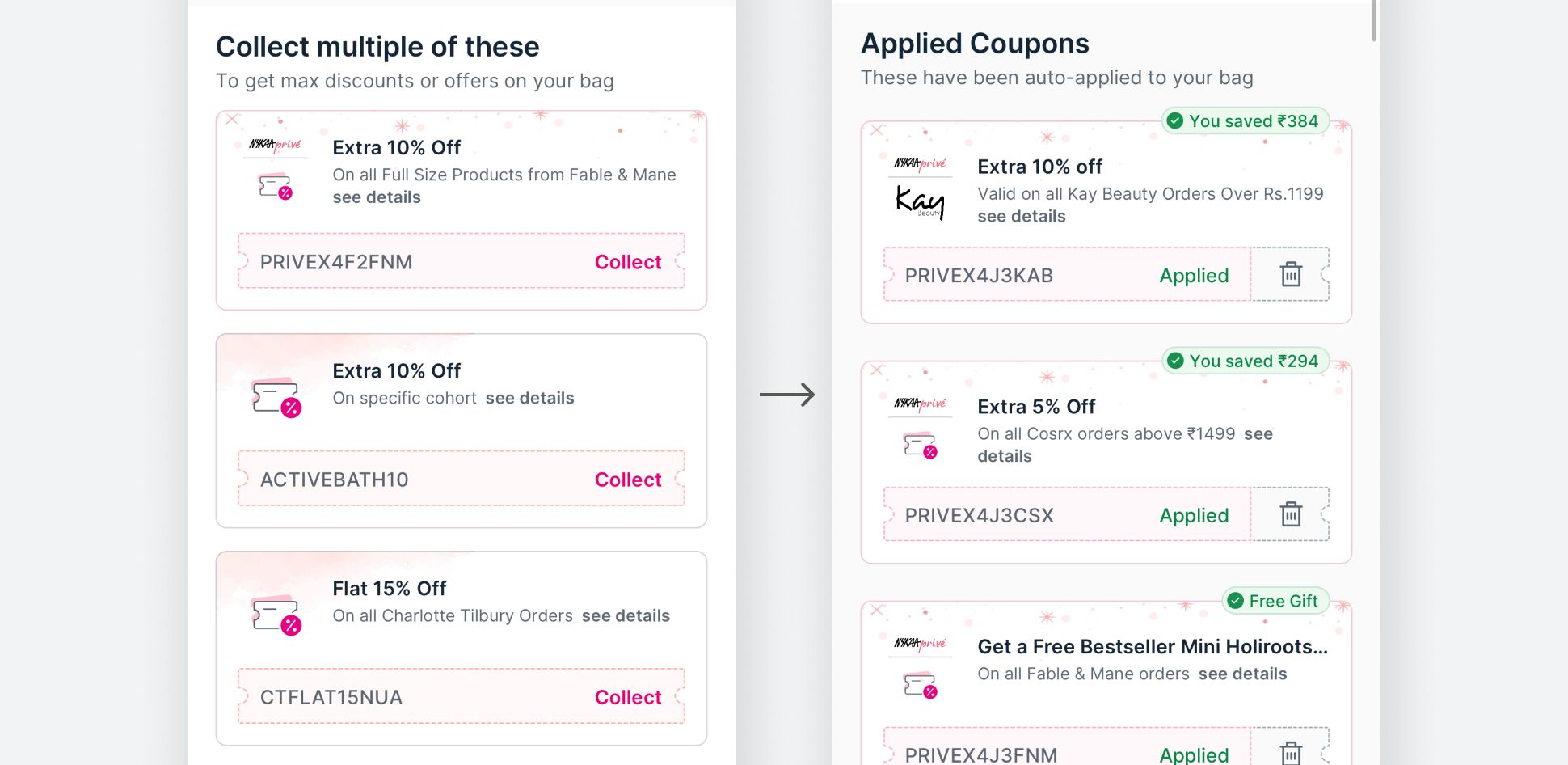
Before removing Collect entirely, we ran a precursor experiment: auto-applying brand-funded coupons users had already collected. Its success gave us the proof — users didn't need to take unnecessary actions for value they'd already opted into. That built the case to move to apply-directly, the mental model users already had from every other platform.
Removing the feature was the hardest part of the work, and not for design reasons. In a product this size, removing a feature is harder than adding one — even when stakeholders agree with the data, they're scared of a visible change. The real work was the convincing: holding the line on the research, and being patient with the people who had the authority to greenlight it. This is the part of design leadership that lives outside the Figma file.
// C. Coupons page redesign (Q3 FY26)
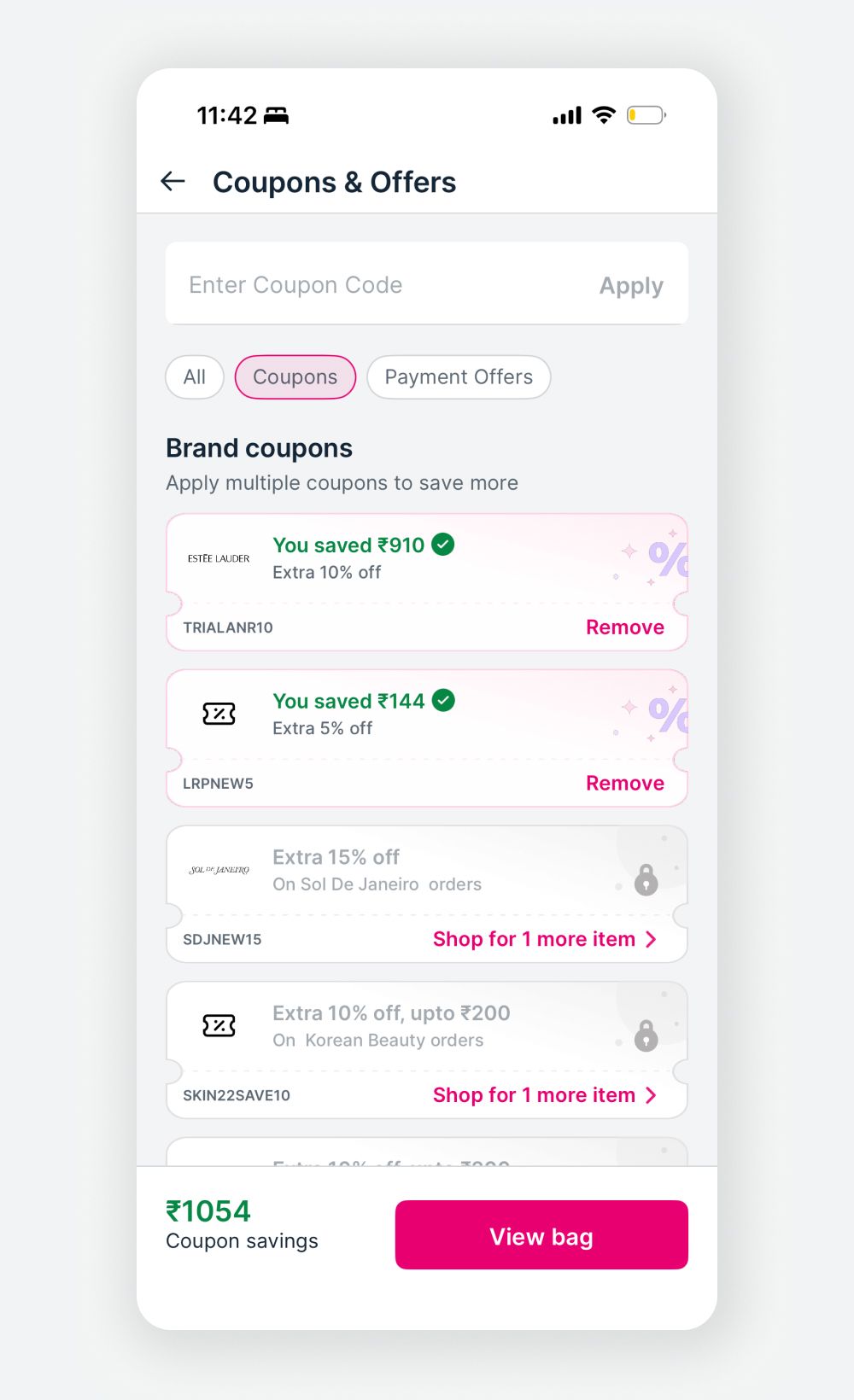
We restructured the Coupons page into two clear sections: Only for You (Nykaa-funded, single-select) and Brand Coupons (multi-select). We surfaced payment offers earlier instead of burying them at checkout, and introduced a timer for urgency when expiry was within 24 hours.
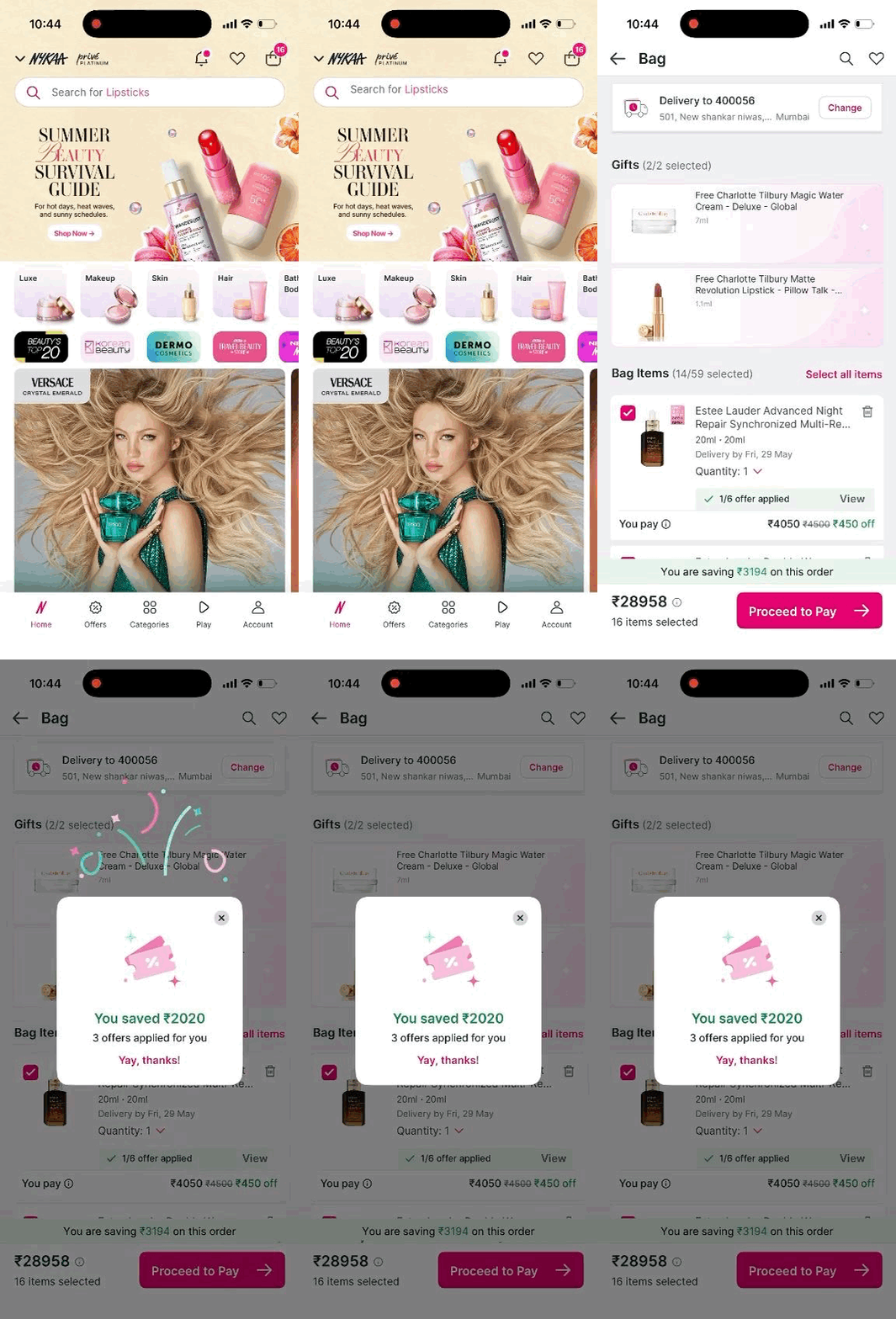
Combined with the Collect removal and the new cards across PDP and Cart: Cart View → Order +10 bps, overall CVR +2 bps, orders with coupons +27 bps, coupon page loads +325 bps, coupons applied +20 bps, AOV +₹13.82 with ABS improvement, revenue per visit +₹0.93. Scaled to 100% of users; projected incremental ARR ₹102 Cr.
// D. Free gifts on PDP (Q3 FY26)
Users are often more incentivised by a tangible free gift than an equivalent discount, especially in beauty. Brands fund these gifts, so every conversion driven by one saves Nykaa burn versus a coupon-driven one — and luxe brands roll out minis through sale events, one of the most attractive levers we have.
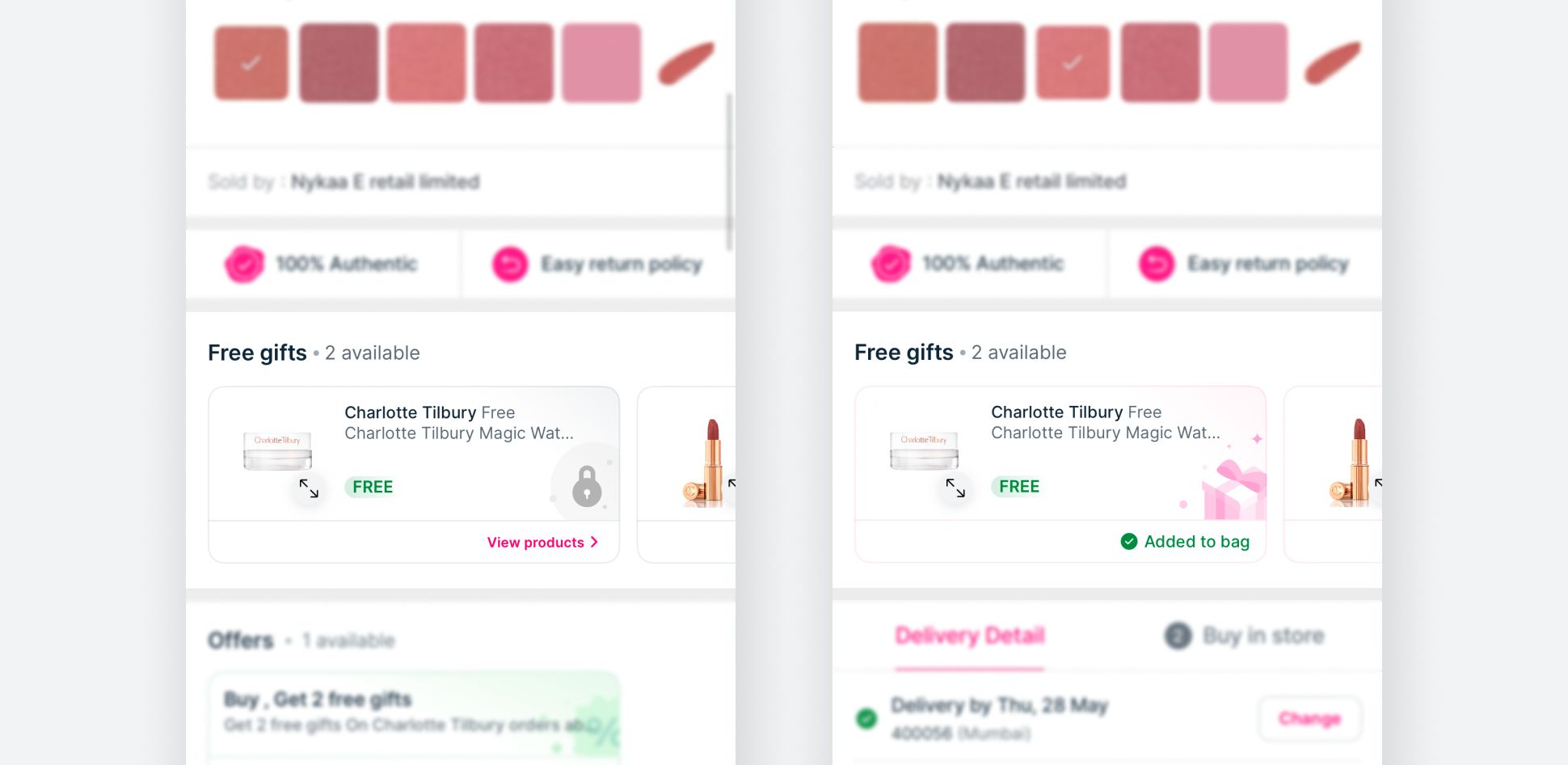
The old experience buried gifts inside the common offer widget: small image, sometimes none at all, unclear eligibility, no excitement. We pulled free gifts into their own section, gave them prominence with product image and name, made unlock criteria clear upfront, and confirmed the gift had been added to bag once eligibility was met.
PDP (with free gift) → ATC +10 bps, → Order +5 bps. AOV +₹2.65. Revenue per visit +₹0.35. Scaled to 100% of users; projected incremental ARR ₹38.6 Cr.
// Outcomes
The coupon experience scaled to 100% of users, delivering ₹102 Cr projected incremental ARR; free gifts on PDP delivered a further ₹38.6 Cr.
Design teams are usually expected to deliver the right visual solution — even for a problem statement that wasn't the right one to begin with. That's why I start with first principles: what does the user actually need, where are the gaps, and do our old limitations still hold?
When we revisited this project, the cards were never the point. The system was. The communication was. And the work was never just design's — it just happened to be the team willing to do it.
// Next up